
The Difference Between Benign Moles and Skin Cancer
- posted: Oct. 26, 2025
Understanding Moles and Skin Changes
Nearly everyone has moles—small clusters of pigmented skin cells that can appear anywhere on the body. Most moles are completely harmless, but changes in their size, color, or shape can sometimes signal something more serious. At Seraly Dermatology in McMurray, PA, Dr. Mark P. Seraly and his team provide comprehensive skin cancer screenings to help patients recognize the difference between normal moles and those that may require closer evaluation.
What Makes a Mole Benign
Benign moles are usually uniform in color, round or oval in shape, and have smooth, well-defined borders. They tend to remain consistent over time and may gradually lighten or flatten with age. These moles form from clusters of melanocytes, the cells responsible for producing pigment in the skin, and are generally harmless. Still, even noncancerous moles should be checked periodically for changes, especially in areas frequently exposed to the sun.
Warning Signs of Skin Cancer
Skin cancer can begin as an irregular mole or new growth that looks or feels different from the rest. The ABCDE rule is a simple guide for spotting potentially cancerous lesions:
A – Asymmetry: One half of the mole doesn’t match the other.
B – Border: The edges are uneven, blurred, or irregular.
C – Color: Multiple shades of brown, black, red, or white are present.
D – Diameter: The mole is larger than a pencil eraser (about 6 mm).
E – Evolving: The mole changes in size, shape, or sensation over time.
Other warning signs include itching, bleeding, or sores that do not heal. Melanoma, the most serious form of skin cancer, can progress quickly—making early detection through routine skin exams essential.
Professional Skin Cancer Screenings at Seraly Dermatology
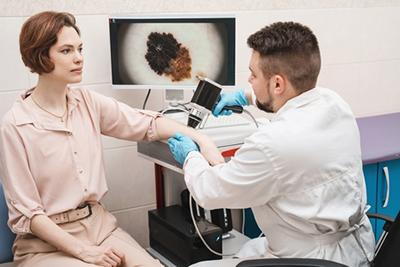
During a skin cancer screening, Dr. Seraly performs a thorough head-to-toe visual exam using specialized instruments to identify any unusual or changing moles. If a suspicious area is found, a quick and nearly painless biopsy can determine whether cancer cells are present.
At Seraly Dermatology, screenings are customized to each patient’s unique risk profile, taking into account factors such as sun exposure, skin type, family history, and number of moles. This individualized approach allows for earlier detection and more effective treatment when needed.
Protecting Your Skin for the Future
Skin cancer prevention begins with consistent protection. Applying sunscreen daily, wearing protective clothing, and avoiding direct sun exposure during peak hours can significantly reduce your risk. Between professional check-ups, monthly self-exams are equally important—monitor your skin for new or changing moles, and contact your dermatologist promptly if something looks unusual.
Schedule Your Skin Cancer Screening
Early detection can make all the difference. At Seraly Dermatology in McMurray, PA, Dr. Mark P. Seraly and his experienced team provide expert mole evaluations and skin cancer screenings in a caring, professional environment. Call (724) 969-2500 today to schedule your appointment and take a proactive step toward protecting your skin health.
- posted: Oct. 26, 2025
Understanding Moles and Skin Changes
Nearly everyone has moles—small clusters of pigmented skin cells that can appear anywhere on the body. Most moles are completely harmless, but changes in their size, color, or shape can sometimes signal something more serious. At Seraly Dermatology in McMurray, PA, Dr. Mark P. Seraly and his team provide comprehensive skin cancer screenings to help patients recognize the difference between normal moles and those that may require closer evaluation.
What Makes a Mole Benign
Benign moles are usually uniform in color, round or oval in shape, and have smooth, well-defined borders. They tend to remain consistent over time and may gradually lighten or flatten with age. These moles form from clusters of melanocytes, the cells responsible for producing pigment in the skin, and are generally harmless. Still, even noncancerous moles should be checked periodically for changes, especially in areas frequently exposed to the sun.
Warning Signs of Skin Cancer
Skin cancer can begin as an irregular mole or new growth that looks or feels different from the rest. The ABCDE rule is a simple guide for spotting potentially cancerous lesions:
A – Asymmetry: One half of the mole doesn’t match the other.
B – Border: The edges are uneven, blurred, or irregular.
C – Color: Multiple shades of brown, black, red, or white are present.
D – Diameter: The mole is larger than a pencil eraser (about 6 mm).
E – Evolving: The mole changes in size, shape, or sensation over time.
Other warning signs include itching, bleeding, or sores that do not heal. Melanoma, the most serious form of skin cancer, can progress quickly—making early detection through routine skin exams essential.
Professional Skin Cancer Screenings at Seraly Dermatology
During a skin cancer screening, Dr. Seraly performs a thorough head-to-toe visual exam using specialized instruments to identify any unusual or changing moles. If a suspicious area is found, a quick and nearly painless biopsy can determine whether cancer cells are present.
At Seraly Dermatology, screenings are customized to each patient’s unique risk profile, taking into account factors such as sun exposure, skin type, family history, and number of moles. This individualized approach allows for earlier detection and more effective treatment when needed.
Protecting Your Skin for the Future
Skin cancer prevention begins with consistent protection. Applying sunscreen daily, wearing protective clothing, and avoiding direct sun exposure during peak hours can significantly reduce your risk. Between professional check-ups, monthly self-exams are equally important—monitor your skin for new or changing moles, and contact your dermatologist promptly if something looks unusual.
Schedule Your Skin Cancer Screening
Early detection can make all the difference. At Seraly Dermatology in McMurray, PA, Dr. Mark P. Seraly and his experienced team provide expert mole evaluations and skin cancer screenings in a caring, professional environment. Call (724) 969-2500 today to schedule your appointment and take a proactive step toward protecting your skin health.
This website includes materials that are protected by copyright, or other proprietary rights. Transmission or reproduction of protected items beyond that allowed by fair use, as defined in the copyright laws, requires the written permission of the copyright owners.
Our Location
Find us on the map
Seraly Dermatology
222 East McMurray Road
McMurray, PA 15317, US
